
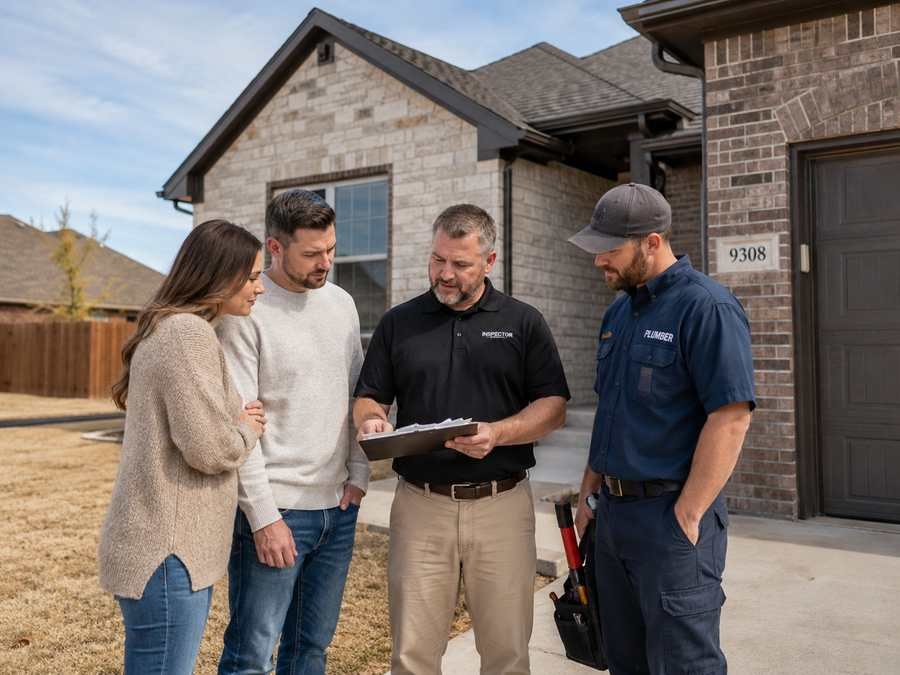
If you are buying a home in the OKC Metro, we provide sewer camera inspection and focused plumbing evaluation services for homebuyers in Oklahoma City, Yukon, Mustang, Piedmont, and surrounding communities.
A general home inspection gives you valuable information about visible plumbing, but three additional checks can give you a clearer picture before closing: a sewer camera inspection, a water pressure and flow evaluation, and a closer review of the water service, shutoff system, and concealed leak indicators.
The most important of these for many buyers is the sewer camera inspection. The main sewer line is underground, so faucets can flow, toilets can flush, and sinks can drain normally while the buried sewer lateral still has conditions that deserve attention.
For a homebuyer, the goal is simple. Learn as much as reasonably possible about the plumbing system while you still have time to make informed decisions about the property.
Quick Answer: What Plumbing Checks Should OKC Homebuyers Add?
Before purchasing a home in Oklahoma City or the surrounding metro, consider adding these three plumbing checks to your due diligence:
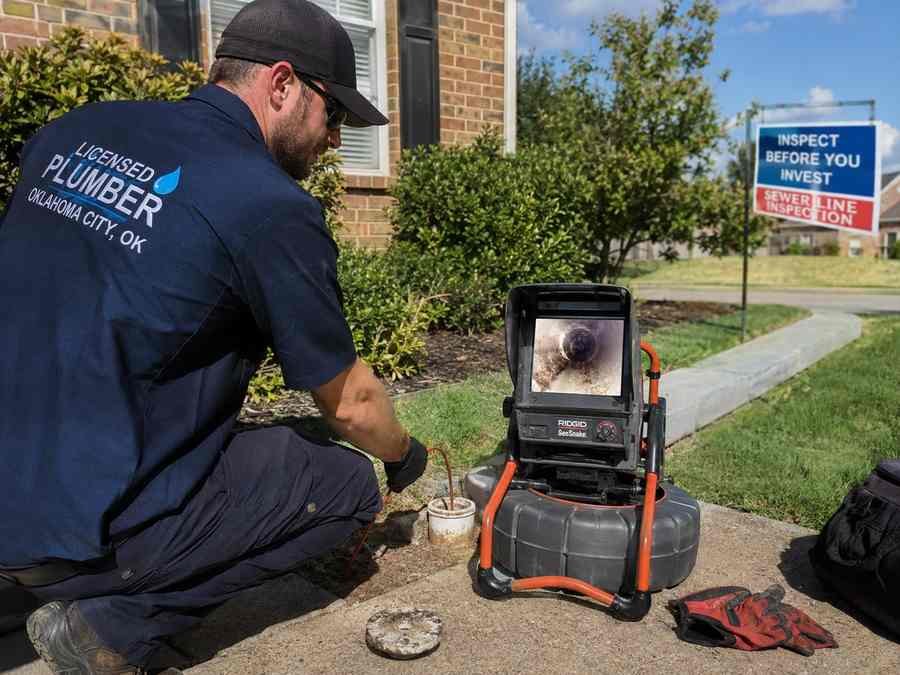
- Sewer camera inspection from the home toward the main sewer connection.
- Water pressure and flow testing under realistic household demand.
- Water service, shutoff, pipe transition, and concealed moisture evaluation.
These checks complement a standard home inspection. They are not a replacement for one.
Why a Good Home Inspection May Still Leave Plumbing Questions
Home inspectors perform an important role in the buying process. They evaluate a broad range of systems throughout the property, including accessible plumbing fixtures, visible supply piping, drainage components, water heating equipment, structure, electrical equipment, HVAC systems, roofing, and other components.
That breadth is exactly why buyers should understand the difference between a general home inspection and a specialized plumbing inspection.
Oklahoma home inspection standards focus on readily accessible systems and components. The standards also state that inspectors are not required to determine the integrity of underground systems, including main drain lines connecting to sewers and underground water lines.
The plumbing standards include evaluation of interior water distribution, fixture flow and drainage, drain and vent components, water heating equipment, and other accessible plumbing components.
That means your inspector may correctly report that the toilets flush and the sinks drain while the condition of the buried sewer lateral remains outside the standard inspection.
Understanding this distinction helps you add the right specialized checks without assuming anything was overlooked.
Plumbing Check 1: Get a Sewer Camera Inspection Before Closing
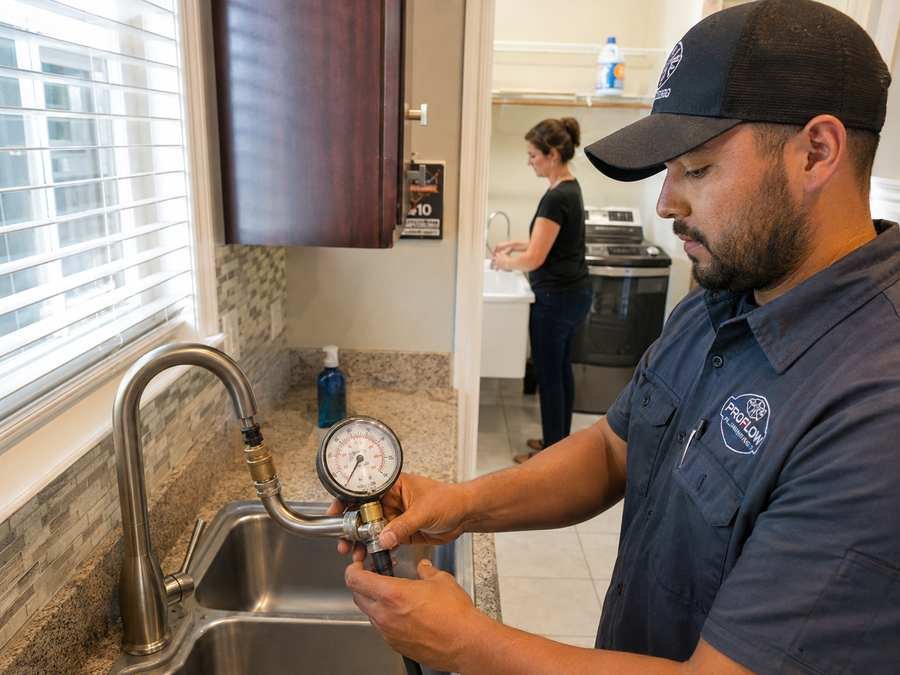
A sewer camera inspection gives a homebuyer a direct view inside the main wastewater pipe that carries drainage away from the house.
The service may also be described as a:
Sewer scope inspection
Sewer video inspection
Drain camera inspection
Sewer line inspection
Main line camera inspection
Sewer lateral inspection
These terms generally describe the same core process.
A flexible waterproof camera is introduced through an accessible sewer cleanout or another appropriate access point. The camera travels through accessible portions of the main sewer line while the technician views the interior of the pipe.
A professional sewer scope can document pipe material and visible conditions such as root intrusion, cracks, separated joints, offset connections, corrosion, blockages, deformation, and areas where water collects because the pipe has developed a low section.
Why Flushing the Toilets Is Not the Same as Scoping the Sewer
This distinction is especially important for homebuyers.
Imagine that every sink drains well during the home inspection.
The toilets flush normally.
The shower drains.
The washing machine connection looks clean.
Those observations are useful, but they primarily tell you that wastewater is moving through the plumbing at that moment.
They do not provide a complete visual assessment of the underground sewer lateral.
A sewer line can still carry water while the camera reveals a condition worth understanding.
For example, a pipe joint can have early root entry while water continues to pass through it. A section can hold some standing water while the rest of the line remains functional. An older pipe can show internal wear while the home still has normal everyday drainage.
That is why the camera provides a different type of information.
It changes the question from:
“Does this drain today?”
to:
“What does the inside of the main sewer line look like?”
That is much more useful information when you are deciding what property you are about to own.
What Should the Sewer Camera Reach?
When practical access allows it, ask what portion of the main line will be viewed and whether the camera can travel toward the municipal connection.
Do not assume that inserting a camera a short distance automatically means the entire accessible sewer lateral was evaluated.
Before the inspection, ask:
Where will the camera enter the line?
How much of the lateral can normally be viewed?
Will I receive video or images?
Will the technician identify the pipe material?
Will important findings be located by distance?
Will the report explain whether a finding appears to call for maintenance, additional evaluation, cleaning, or repair planning?
The objective is not simply to receive a video.
The objective is to receive information you can understand.
What Does Root Intrusion Look Like?
Tree roots naturally seek moisture.
If roots find an opening around an older joint or another entry point, they can begin growing into the sewer line.
A small amount of root growth does not automatically mean the entire sewer needs replacement.
The location, density, pipe material, condition of surrounding joints, and amount of remaining flow all matter.
This is where professional interpretation becomes important.
The useful question is not simply:
“Are there roots?”
It is:
“What do these roots tell us about the condition of this specific section of pipe?”
What Is a Sewer Pipe Belly?
A pipe belly is a low section of the sewer lateral where water can collect instead of continuing along a consistent slope.
The camera may travel into standing water and then emerge as it passes through the low section.
Again, context matters.
The amount of standing water, length of the low area, drainage performance, surrounding pipe condition, and history of recurring drain service can all help determine the significance of the finding.
This is another reason the video should be interpreted rather than treated as a simple pass or fail test.
Why Pipe Material Matters
A sewer camera may also help identify the material used in accessible sections of the lateral.
Depending on the age and construction history of a property, a plumbing professional may encounter materials such as:
PVC
Cast iron
Clay pipe
Orangeburg
Different materials age differently and respond differently to ground movement, joints, moisture, roots, corrosion, and previous repairs.
Knowing the material helps establish context for what appears on camera.
It also gives the buyer useful information for future maintenance planning.
Do Newer Homes in Yukon, Mustang, or Piedmont Need a Sewer Scope?
Possibly, yes.
A common assumption is that sewer camera inspections are only valuable for older Oklahoma City properties.
Age certainly matters, but it is not the only consideration.
Buyers looking at newer homes and subdivisions in Yukon, Mustang, Piedmont, and other growing parts of the OKC Metro should remember that a newer home still has underground drainage piping.
A camera inspection can provide useful information about installation, slope, connections, debris, and current pipe condition.
New construction also deserves its own mindset.
When a property is newer, you are usually looking for different things than you would in an older home.
In an older property, pipe material, aging joints, root entry, corrosion, and previous repairs may deserve closer attention.
In a newer property, the questions may center on alignment, drainage slope, connections, construction debris, cleanout access, and whether the installed system is performing as intended.
New does not mean inspection has no value. It simply changes what you are evaluating.
Plumbing Check 2: Test Water Pressure and Flow Under Realistic Demand
A second useful plumbing check is to evaluate how the home’s water supply performs when several fixtures are operating.
One faucet can tell you only so much.
During everyday living, a household may use the kitchen faucet, a shower, a toilet, a washing machine, and other fixtures within the same period.
A plumbing evaluation can therefore consider both water pressure and water flow under demand.
Professional plumbing evaluations may include static pressure measurement while fixtures are closed and observation of flowing pressure while water is being used.
Why Water Pressure Should Be Measured
Buyers often test water pressure by turning on the shower and judging how the stream feels.
That is useful as a basic observation, but a gauge provides more meaningful information.
Pressure and available flow can be influenced by several components, including:
The main water service
The main shutoff valve
A pressure regulator where one is installed
Pipe diameter
Pipe material
Internal restriction
Fixture components
Water treatment equipment
Municipal supply conditions
The goal is to understand how the system behaves rather than to judge one faucet in isolation.
Try the Home Under Realistic Water Demand
One of the simplest ways to learn more about a home’s water distribution is to observe it while multiple fixtures operate.
For example, notice what happens when a shower is running and another fixture is opened.
Does the flow remain comfortable?
Does one area of the house behave differently from another?
Does hot water delivery remain consistent?
Are changes limited to one fixture or visible throughout the house?
Patterns matter.
A single weak faucet may point toward a fixture specific condition.
A similar change throughout the home may justify looking farther upstream in the supply system.
This kind of testing gives homebuyers a more realistic picture of how the house may behave after move in.
Plumbing Check 3: Review the Water Service, Shutoffs, Pipe Transitions, and Concealed Moisture Clues
The third check is less dramatic than a sewer camera, but it can provide valuable information.
Ask the plumbing professional to look beyond whether fixtures simply turn on.
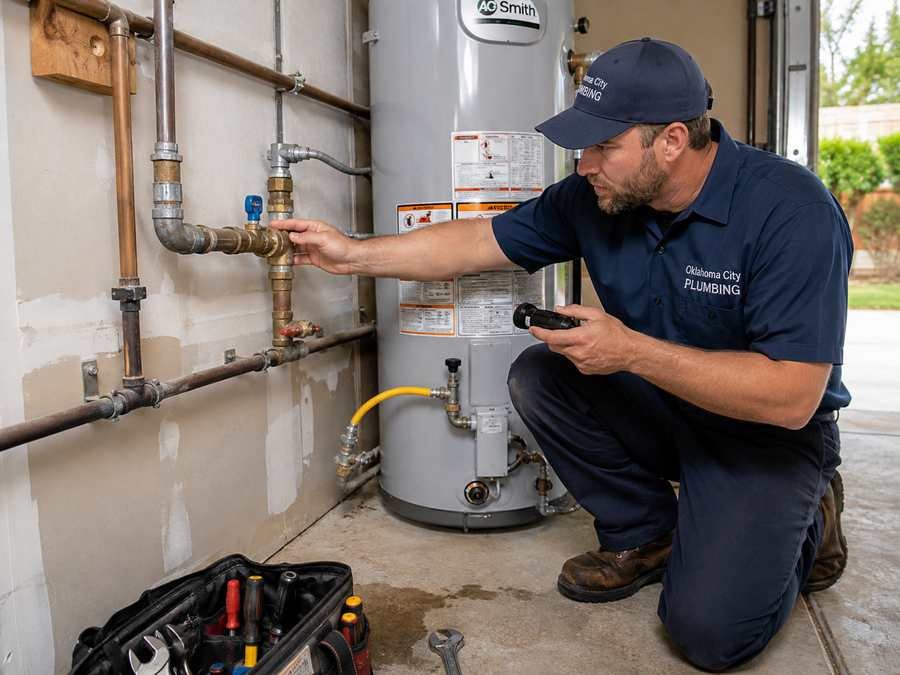
The evaluation can include the main water shutoff, accessible supply piping, plumbing transitions, visible previous repairs, fixture shutoffs, and signs that suggest further leak investigation may be useful.
Locate the Main Water Shutoff Before You Own the House
Every homeowner should know how the home’s water can be controlled.
During the buying process, identify where the main water shutoff is located.
Then look at accessibility.
Can it be reached easily?
Is the surrounding area clear?
Does the valve appear appropriate for professional evaluation?
You generally do not want to discover the location of the main water shutoff for the first time when water is already moving somewhere you do not want it.
Oklahoma home inspection standards call for the inspector to describe the location of the main water shutoff, but inspectors are not required to operate shutoff valves.
That creates a useful follow up question for buyers:
Do I understand the actual serviceability and condition of this valve?
A plumber can determine how the valve and surrounding piping should be evaluated safely.
Look at Pipe Material and Transitions
Accessible plumbing can tell a story about the property.
A home may have original piping in one area and updated piping in another.
An addition may use a different material from the main house.
A remodeled bathroom may contain newer supply connections while other parts of the plumbing remain original.
These transitions are not automatically concerning.
They are simply information.
A good plumbing evaluation considers:
Where materials change
How those transitions were connected
Whether visible piping is supported appropriately
Whether previous repairs appear orderly
Whether shutoff valves are accessible
Whether there are moisture marks around fixtures or penetrations
Whether the plumbing layout appears consistent with the home’s remodeling history
For buyers, this can be especially useful when the seller mentions bathroom, kitchen, laundry, or whole house plumbing upgrades.
Pay Attention to Concealed Plumbing Clues
A visual inspection cannot show everything inside walls or beneath a slab.
However, the property can sometimes provide clues that justify closer evaluation.
Useful observations can include:
Repeated ceiling or wall repairs near plumbing routes.
Cabinet floors with older moisture staining.
Flooring changes around toilets, tubs, or water heaters.
Recent plumbing access patches.
Unusual plumbing transitions.
Evidence of repeated drain cleaning.
Changes in water meter activity when fixtures are expected to be off.
Areas where specialized leak detection may provide additional information.
The goal is not to assume that every mark indicates an active leak.
The goal is to notice patterns and ask better questions.
Ask for the Plumbing History Before Closing
One of the most valuable homebuyer plumbing checks does not require a camera or gauge.
Ask for documentation.
If available, review:
- Sewer cleaning records
- Sewer line repair records
- Plumbing invoices
- Water heater replacement information
- Repiping documentation
- Remodel permits and invoices
- Leak repair records
- Warranty information
- Previous camera inspection footage
- Information about the property’s sewer or septic connection
Repeated work in the same location deserves context.
For example, several drain cleaning visits do not automatically tell you there is a structural sewer condition. They do tell you that asking why the service was repeatedly needed could be useful.
Records help connect the visual inspection with the property’s actual maintenance history.
Municipal Sewer or Septic? Confirm Before You Scope
Before scheduling the inspection, confirm how the property handles wastewater.
A home may connect to a municipal sewer system, or it may use a private septic system depending on the property and available infrastructure.
This distinction matters.
For a municipal sewer property, the sewer camera typically evaluates accessible portions of the building sewer or lateral leading toward the public connection.
For a septic property, the camera may help evaluate the building sewer leading toward the tank, but that does not replace a proper septic system inspection.
The septic tank, treatment components, distribution system, and absorption area require their own evaluation.
This is particularly worth confirming when shopping for larger lots, acreage, or properties farther from established utility infrastructure around the metro.
What Should You Do If the Sewer Camera Finds Something?
Start with context.
A camera finding should create information, not immediate conclusions.
Ask four questions.
1. What exactly are we seeing?
Ask the technician to identify the feature on the video.
Is it root intrusion?
A joint?
A low section?
Internal buildup?
A material transition?
A previous repair?
Pipe wear?
A localized obstruction?
The more precise the description, the easier the next decision becomes.
2. Where is it located?
Distance matters.
If possible, ask where the condition sits relative to the cleanout, foundation, yard, driveway, sidewalk, or public sewer connection.
Location can influence future access and repair planning.
3. How is the line performing?
A visual finding should be considered alongside function.
Ask whether water is flowing normally through the area and whether the finding is affecting the usable diameter or drainage path.
4. What is the appropriate next step?
Not every finding requires the same response.
Depending on the condition, the appropriate recommendation may involve routine monitoring, drain cleaning, root management, another camera run after cleaning, targeted repair, or a broader sewer line evaluation.
If repair planning becomes appropriate, a licensed plumber can explain the available approaches based on what the camera actually shows.
Why This Matters Before the Purchase Is Complete
A home purchase gives you a limited window to gather information.
Once your offer is accepted, there may be inspections, additional evaluations, document review, negotiations, appraisal, financing, and closing steps happening close together.
That makes scheduling important.
If you want a sewer camera inspection or specialized plumbing evaluation, arrange it early enough that you have time to:
Review the video
Understand the findings
Ask questions
Request additional evaluation when appropriate
Discuss the information with your real estate professional
Review repair documentation
Consider the information as part of your purchase decision
The plumbing inspection should help you make a more informed decision, not create pressure.
A Practical Plumbing Checklist for OKC Metro Homebuyers
Before closing on a home in Oklahoma City, Yukon, Mustang, Piedmont, or another nearby community, make sure you can answer these questions.
Do I know whether the property uses municipal sewer or septic?
Was the underground sewer lateral viewed with a camera?
Do I know what material the accessible sewer pipe appears to be?
Was the camera able to view a meaningful portion of the line?
Do I have video or images of important findings?
Did anyone measure water pressure?
Was water flow observed while multiple fixtures were operating?
Do I know where the main water shutoff is located?
Have visible pipe materials and plumbing transitions been reviewed?
Did I ask for previous sewer, leak, repiping, and plumbing repair records?
If remodeling occurred, do I understand what plumbing was changed?
If the home uses septic, did I arrange the appropriate septic evaluation separately?
If you can answer those questions, you have a much clearer plumbing picture than you would get from simply turning on faucets during a showing.
Older Home Versus Newer Home: What Should You Focus On?
The ideal plumbing inspection changes with the property.
When Buying an Older OKC Home
Give extra attention to:
Sewer pipe material
Joint condition
Root intrusion
Internal corrosion
Previous sewer repairs
Plumbing material transitions
Water pressure
Drain history
Main shutoff accessibility
Remodeled kitchens and bathrooms
When Buying a Newer Home in Yukon, Mustang, or Piedmont?
Give extra attention to:
Sewer alignment
Drainage slope
Construction debris
Cleanout accessibility
Water pressure under full household demand
Fixture installation
Supply connections
Main shutoff location
Municipal sewer versus septic status
Any available builder or plumbing warranty documents
Age changes the inspection priorities, but it does not eliminate the value of inspection.
Related: Lead Safe OKC: How to Check Your Water Service Line Material
Do Not Treat a Sewer Scope as a Pass or Fail Test
One of the most useful things a homebuyer can understand is that plumbing systems rarely fit into a simple good or bad category.
A camera may show an excellent PVC line.
It may show an older line that is still functioning well.
It may identify a localized area that deserves maintenance.
It may reveal a section worth evaluating more closely.
The purpose of the inspection is to create a condition profile.
That profile helps you understand what exists today and what may deserve planning in the future.
A thoughtful plumber should be able to explain the video in plain language.
We are an experienced plumber in Oklahoma City, and one of the most useful things we can give a homebuyer is context. A camera image becomes valuable when you understand what you are looking at, where it is located, and what the finding means for the property.
Related: Landlord vs Tenant Plumbing Responsibilities Under Oklahoma Law
Frequently Asked Questions
Is a sewer camera inspection included in a standard Oklahoma home inspection?
Not necessarily. Oklahoma’s minimum home inspection standards specifically state that inspectors are not required to determine the integrity of underground systems, including main drain lines connecting to sewers. A sewer scope is therefore commonly arranged as an additional inspection.
Should I get a sewer inspection before buying a house in Oklahoma City?
It is worth considering whenever you want direct information about the underground sewer lateral before taking ownership. It can be particularly useful when the home’s age, pipe material, landscaping, drainage history, previous sewer work, or property conditions create unanswered questions.
Is a sewer scope only for older homes?
No. Older properties may present age related pipe considerations, while newer properties can still benefit from confirmation of installation, slope, connections, cleanout access, and current condition.
What can a sewer camera inspection find?
A sewer camera may identify visible root intrusion, cracks, joint separation, offsets, corrosion, buildup, blockages, pipe deformation, standing water, pipe material, and other accessible conditions inside the sewer lateral.
How does a sewer camera inspection work?
A waterproof camera attached to a flexible cable is introduced through an appropriate access point, commonly a sewer cleanout. The technician advances the camera through accessible portions of the line while observing and documenting the interior.
What should I receive after a sewer scope?
Ask whether the service includes recorded video, photographs, written observations, approximate locations of important findings, pipe material information, and an explanation of any areas the camera could not reach.
What if the house does not have an accessible sewer cleanout?
Access options depend on the plumbing system and property. A plumbing professional can determine whether another appropriate access point is available and explain what portion of the line can safely be evaluated.
Should I check water pressure before buying a house?
Yes, pressure measurement and flow testing can add useful information. Observing the system while several fixtures operate can also help identify whether changes are limited to one fixture or affect the broader water distribution system.
What if the property in the OKC Metro has a septic system?
Confirm the wastewater system before ordering inspections. A camera can help evaluate accessible building sewer piping leading toward a septic tank, but it does not replace a dedicated septic inspection.
When should I schedule a plumbing inspection during the home buying process?
Schedule it early enough within your due diligence period to review findings, ask questions, obtain additional evaluation when appropriate, and discuss the information with the professionals assisting with your purchase.
Final Takeaway for OKC Metro Homebuyers
If you are buying a home in the OKC Metro, do not judge the entire plumbing system by how well the kitchen faucet runs during the showing.
Your general home inspection is the foundation of your property evaluation. A specialized plumbing review simply goes deeper in areas where additional information can be valuable.
Remember the three checks:
First, inspect the sewer lateral with a camera.
Second, measure water pressure and observe flow under realistic demand.
Third, review the water service, shutoffs, accessible piping, plumbing transitions, and concealed moisture clues.
For buyers in Oklahoma City, Yukon, Mustang, Piedmont, and surrounding OKC Metro communities, these steps can provide a much more complete understanding of the home’s plumbing before closing.
The most valuable inspection is not the one that produces the longest report.
It is the one that answers the questions that matter before the property becomes yours.