
Your water heater dies faster mainly because of two things happening inside the tank at the same time: sediment settling at the bottom and hard water scale coating the heating surfaces, both of which force the unit to work harder every single day until it wears out years ahead of schedule.
If you live in Oklahoma City, this isn’t a rare occurrence. Our local water supply runs on the harder end of the scale, which means the average tank here works under more mineral stress than a water heater in almost any neighboring state.
We provide water heater repair, tank flushing, anode rod replacement, and full water heater installation right here in Oklahoma City, so if any of what you read below sounds familiar, help is close by.
What Is Really Shortening Your Water Heater’s Lifespan?
Most homeowners assume a water heater simply gets old and stops working. In reality, a properly maintained tank can run for well over a decade, while a neglected one in a hard water city can start showing serious wear in half that time. The difference almost always comes down to two mechanical culprits working together.
The first is sediment, made up of calcium, magnesium, sand, and mineral particles that separate out of your water supply and settle at the bottom of the tank.
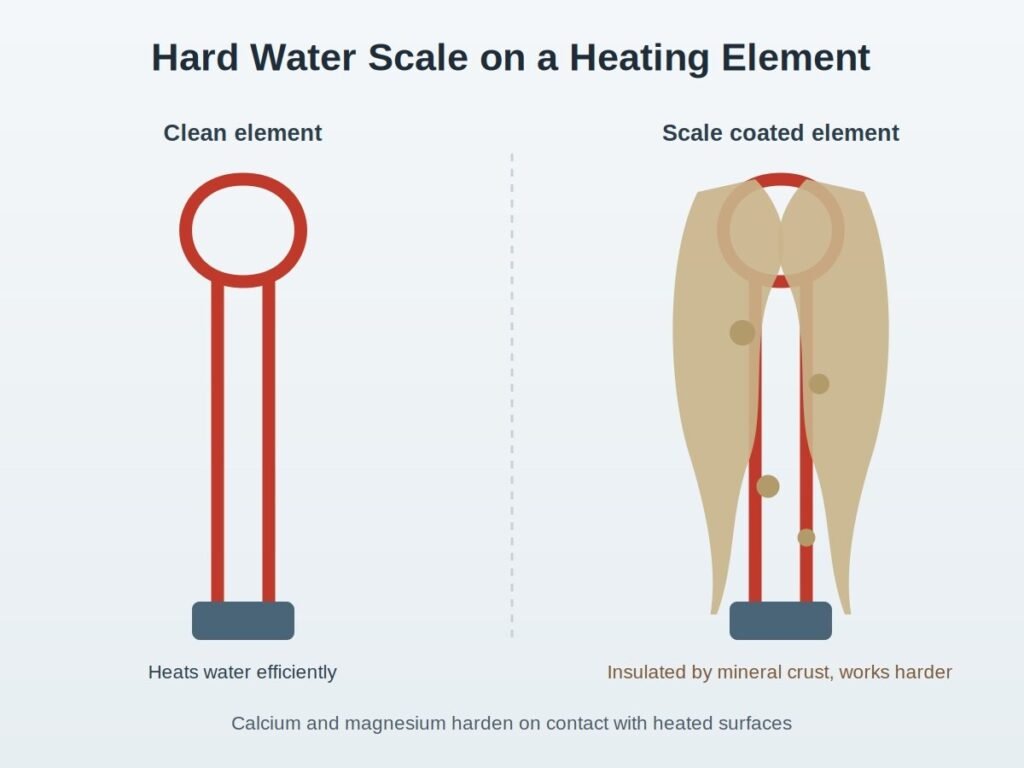
The second is scale, a hardened mineral crust that forms directly on heating elements, burner surfaces, and the tank lining once water is heated repeatedly.
Both problems start on day one of installation and build quietly, month after month, until your energy bill, your hot water supply, and eventually your tank itself start to show strain.
Sediment Buildup at the Bottom of the Tank
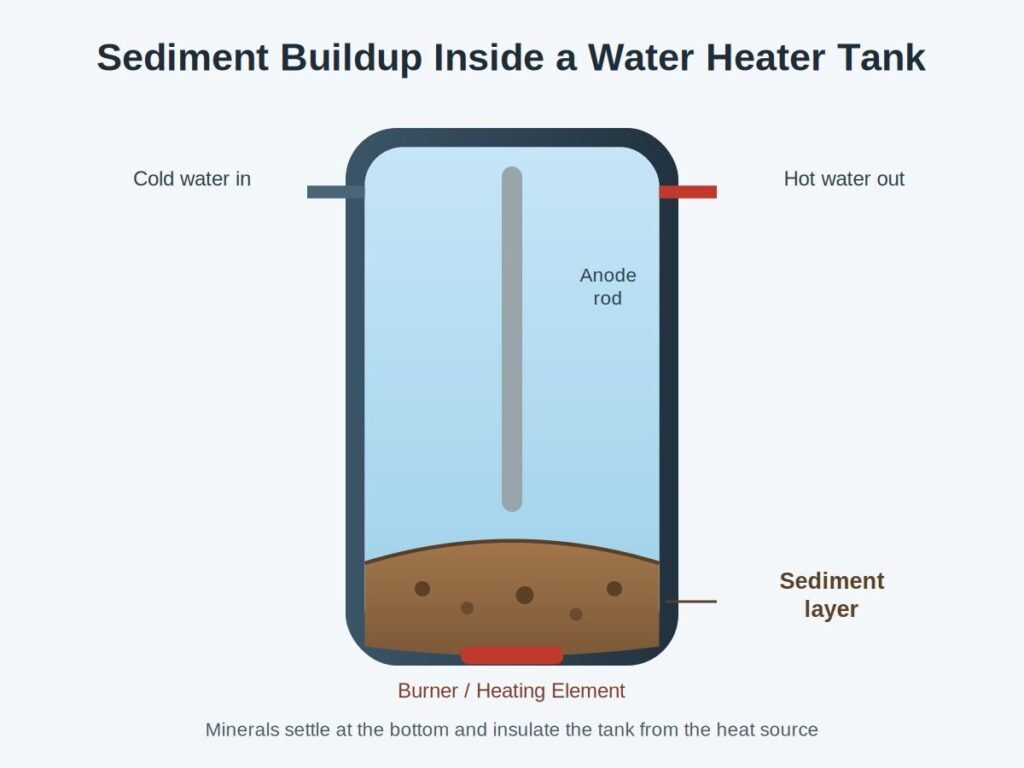
Every gallon of water that enters your home carries dissolved minerals with it. Inside a traditional tank, water sits and reheats constantly, giving those minerals time to separate and fall to the bottom, where they harden into a dense, compact layer.
That layer acts like a blanket between the burner or heating element and the water above it. In a gas unit, the flame has to push heat through the sediment before it ever reaches the water, which wastes fuel and extends recovery time.
In an electric unit, the lower heating element can become partially buried, causing it to overheat, cycle on and off more frequently, and burn out well before its expected service life.
This is also the source of the popping, cracking, or rumbling sound many Oklahoma City homeowners hear when their water heater kicks on.
That noise is trapped water boiling underneath the sediment layer and pushing steam bubbles up through it. It is one of the clearest audible warning signs that a tank needs professional attention.
Left alone, sediment does more than slow things down. It traps moisture against the steel lining of the tank, which speeds up rust formation from the inside out. Once a tank develops an internal leak from corrosion, repair is no longer an option and full replacement becomes the only path forward.
How Hard Water Scale Reduces Heating Efficiency?
Oklahoma City’s water supply is classified as hard to very hard, generally landing somewhere between 9 and 13 grains per gallon depending on your exact location and source. That places local homes well above the level where scale becomes a real mechanical concern.
Here’s the chemistry behind it: calcium and magnesium are less soluble in hot water than in cold water. The instant your water heater raises the temperature, those minerals start precipitating out of solution and turning into solid calcium carbonate crystals.
Those crystals attach directly to the surfaces doing the heating, whether that’s an electric element or the base of a gas tank.
Once that mineral layer forms, it behaves like insulation on the wrong side of the equation. Instead of keeping heat in, it keeps heat out of the water and traps it against the metal instead. Your thermostat still calls for the same temperature, so the unit simply runs longer and harder to reach it.
Industry estimates suggest a heavily scaled system can require 30 to 40 percent more energy to deliver the same amount of hot water compared to a clean one, and that additional strain shows up directly on your monthly utility bill.
Scale also accelerates wear on the anode rod, the sacrificial metal rod suspended inside every tank whose entire purpose is to attract corrosive elements before they reach the steel lining.
Heavy mineral concentration speeds up how quickly that rod dissolves. Once it’s fully spent, corrosion protection disappears and the tank itself becomes the next target.
Warning Signs Your Water Heater Is Struggling
Because sediment and scale build up gradually, most homeowners don’t notice until symptoms are already well established. Watch for:
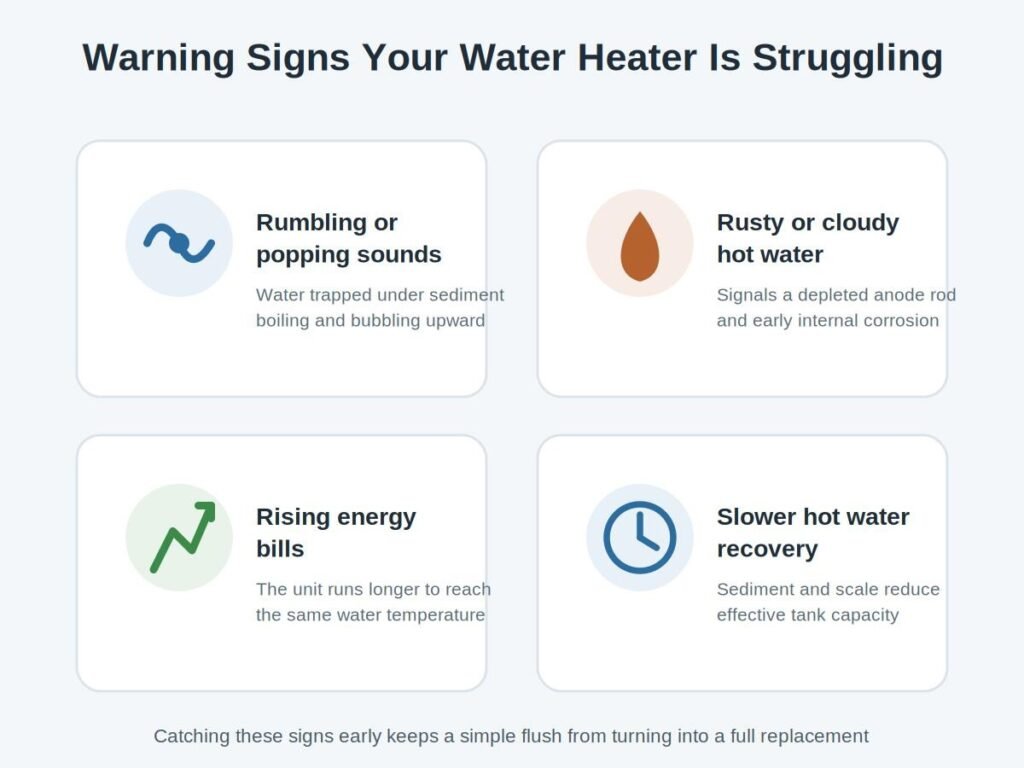
Longer wait times for hot water. Recovery time increases as the heating surface becomes coated and less efficient.
Rumbling, popping, or crackling sounds. This points directly to sediment trapped beneath the heating source.
Rising energy bills without a change in usage. A unit working harder to reach the same temperature pulls more gas or electricity.
Reduced hot water supply. Sediment physically takes up space that used to hold usable water, shrinking your effective tank capacity.
Rusty, cloudy, or metallic smelling water. This often signals a depleted anode rod and the early stages of internal corrosion.
Water pooling around the base of the unit. This can indicate a stressed tank seam, a failing pressure relief valve, or a lining breach.
How to Fix It?
The good news is that most of this damage is preventable, and much of it is reversible if you catch it early enough.
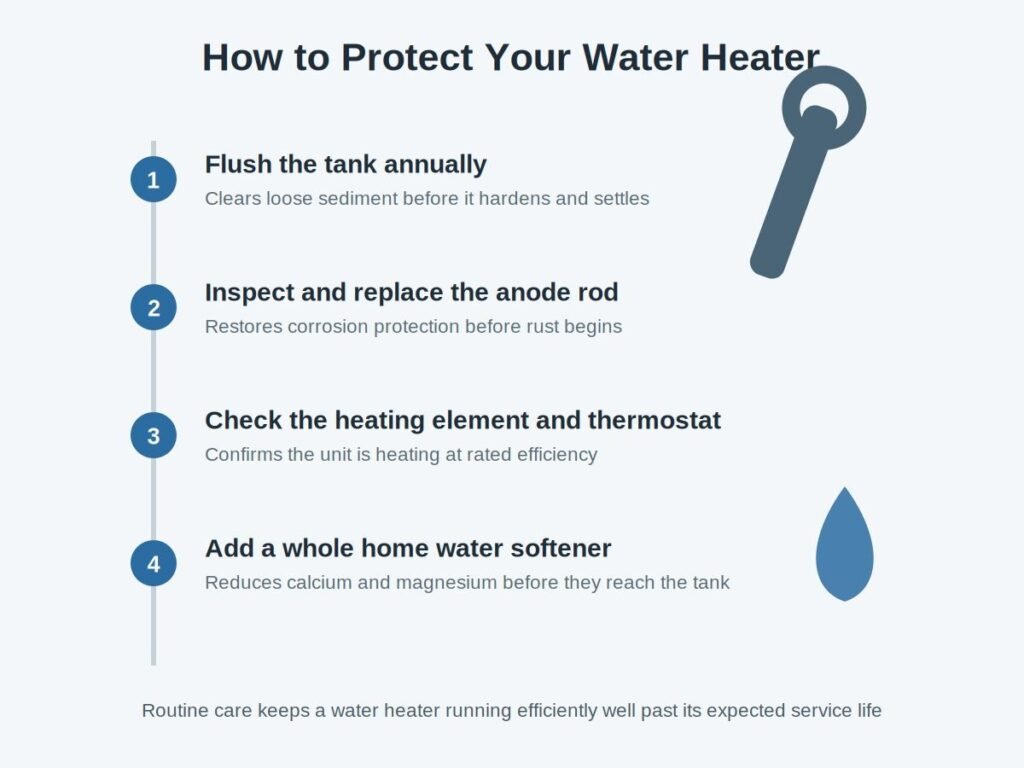
Annual tank flushing. Draining the tank fully and flushing out loose sediment restores heating efficiency and reduces strain on the burner or elements.
In a hard water market like Oklahoma City, flushing once a year is the baseline recommendation, and homes on well water or with especially high mineral content may benefit from flushing twice a year.
Anode rod inspection and replacement. A rod that’s more than half consumed should be swapped out before it stops offering protection. This single, low cost component is often the difference between a tank that lasts 8 years and one that lasts 15.
Heating element and thermostat checks. For electric units, a scaled or damaged element pulls more power and heats less effectively. Replacing it restores performance without requiring a full system replacement.
Whole home water softening. Treating hardness before it ever reaches your water heater is the most permanent fix available. A properly sized softener reduces the calcium and magnesium load across your entire plumbing system, not just the tank, which extends the life of fixtures, appliances, and pipes at the same time.
Professional inspection at the first sign of trouble. Catching sediment and scale early usually means a simple flush or part replacement. Waiting until a tank is leaking removes repair from the table entirely.
Does This Affect Tankless Systems Too?
Tankless water heaters don’t build the same sediment layer at the bottom of a tank, since there’s no standing reservoir of water. However, they are not immune to hard water.
Mineral content still passes through the narrow heat exchanger every time hot water is called for, and over time that exchanger can scale up internally, restricting flow and reducing efficiency.
Tankless units generally need descaling on a regular schedule in hard water regions, which is a faster and less invasive service than a full tank flush but still essential for keeping the system running at its rated efficiency.
Related: How to Properly Flush Your Water Heater to Clear Oklahoma Sediment?
Local Water Heater Service in Oklahoma City
Because Oklahoma City’s water hardness sits well above the national average, timelines that apply to other regions often don’t hold true here.
A tank rated for 12 years of service elsewhere may show meaningful wear in half that time without regular flushing and anode rod maintenance.
Our team handles tank flushing, anode rod replacement, heating element repair, complete water heater installation, and whole-home water softener setup for both gas and electric systems across Oklahoma City and the surrounding area.
Same-day appointments are available for units already showing warning signs, and every visit includes a straightforward diagnosis before any work begins.
With years of hands-on experience serving local homeowners, we’re proud to be one of the most experienced plumbing teams in Oklahoma City.
Related: What Oklahoma’s Heavy Spring Thunderstorms Mean for Your Sump Pump?
Frequently Asked Questions
Why does my water heater make a rumbling noise?
Rumbling or popping sounds happen when water becomes trapped underneath a layer of sediment at the bottom of the tank and boils, sending bubbles up through the debris. It’s one of the earliest and most reliable warning signs of sediment buildup.
How often should a water heater be flushed in Oklahoma City?
Once a year is the standard recommendation for most homes given the local water hardness, with twice a year suggested for well water systems or households with especially high mineral content.
Can hard water actually shorten a water heater’s lifespan?
Yes. Hard water accelerates sediment accumulation and scale formation on heating surfaces, which increases energy use, slows recovery time, and speeds up anode rod depletion and internal corrosion, all of which shorten the unit’s usable life.
What’s the average lifespan of a water heater in a hard water area like Oklahoma City?
Many tanks in Oklahoma City show meaningful wear between 8 and 12 years without regular maintenance, compared to 12 years or more in regions with softer water.
Does a water softener actually help my water heater last longer?
Yes. A correctly sized whole home softener reduces the calcium and magnesium entering the tank in the first place, which slows both sediment accumulation and scale formation at the source rather than only treating the symptoms afterward.
Is it worth repairing an older water heater with sediment buildup, or should I replace it?
It depends on the extent of the buildup and the condition of the tank lining. Moderate sediment usually responds well to flushing and anode rod replacement. Once internal corrosion has started or the tank has begun leaking, replacement becomes the more reliable option.